

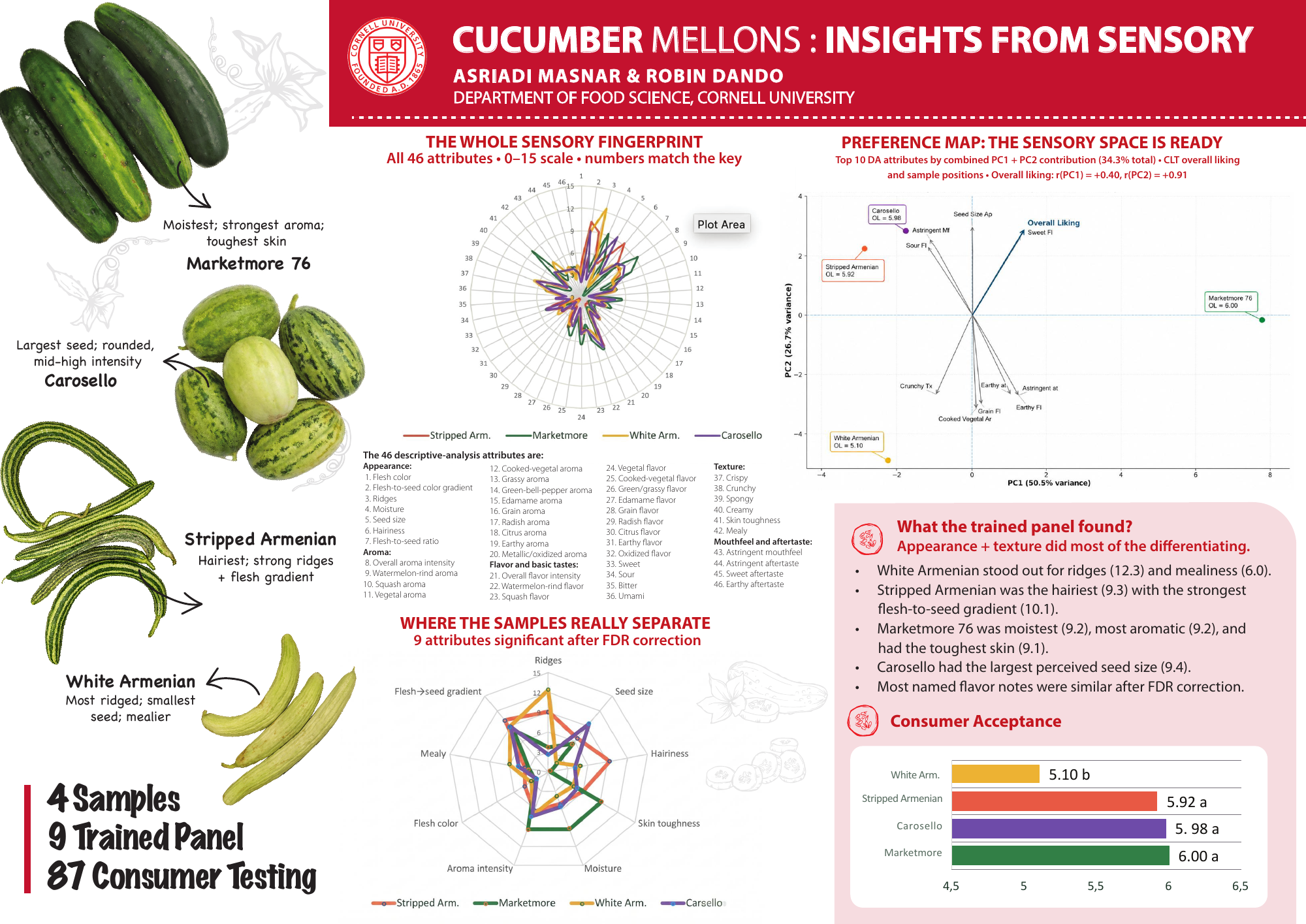
How do cucumber melons differ in appearance, aroma, flavor, texture, and consumer acceptance? This research poster summarizes a sensory study of four distinctive samples and maps the attributes that most clearly separate them.
Study overview
The study compared Marketmore 76, Carosello, Stripped Armenian, and White Armenian. A trained panel of nine assessors evaluated 46 descriptive-analysis attributes on a 0–15 scale, while 87 consumers participated in acceptance testing.
What differentiated the samples?
- White Armenian stood out for ridges (12.3) and mealiness (6.0).
- Stripped Armenian was the hairiest sample (9.3) and showed the strongest flesh-to-seed color gradient (10.1).
- Marketmore 76 was the moistest (9.2), most aromatic (9.2), and had the toughest skin (9.1).
- Carosello had the largest perceived seed size (9.4).
- Most named flavor notes were similar after false discovery rate correction, indicating that appearance and texture contributed most strongly to product differentiation.
Consumer acceptance
Marketmore 76 received the highest mean overall-liking score (6.00), followed closely by Carosello (5.98) and Stripped Armenian (5.92). White Armenian received a lower mean score of 5.10 and was reported in a different significance group. In the preference map, overall liking was more strongly associated with PC2 (r = 0.91) than with PC1 (r = 0.40).
Research perspective
These results show that cucumber-melon diversity is expressed most clearly through visible and textural characteristics. Linking descriptive sensory profiles with consumer responses can help researchers and product developers identify traits that support acceptance while preserving distinctive varietal qualities.
Authors: Asriadi Masnar and Robin Dando
Affiliation: Department of Food Science, Cornell University