

You’re finishing (or have finished) your Master’s, or you’re working in industry/research and want to pursue a PhD in a specific lab.
Cold-emailing professors feels terrifying and most messages never get a reply.
This template changes that.
I used it as a Master’s student (and later as a research engineer) to contact leading professors I had never met. Even when I sent the emails on Friday evenings, I started getting enthusiastic replies within hours — invitations to chat, requests for my CV, and several direct PhD offers.
Here is the exact template + small tweaks that work.
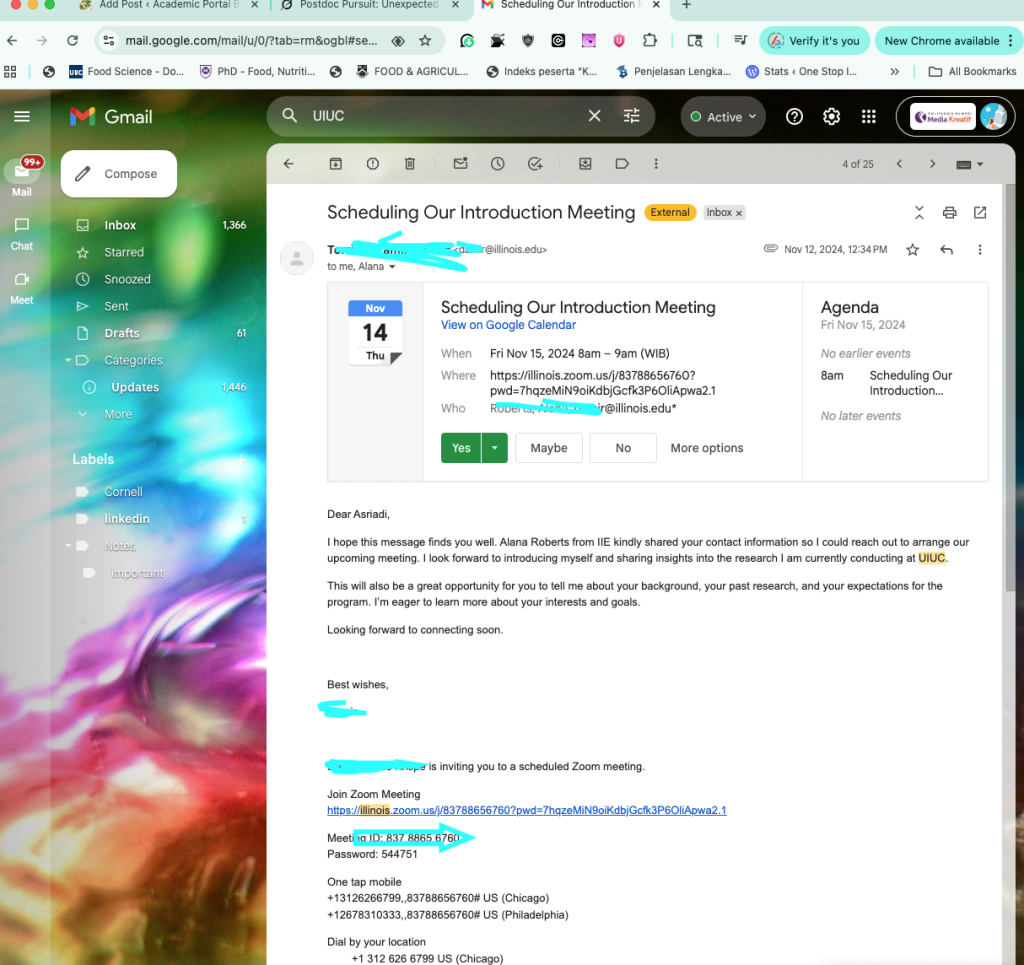
Plug-and-Play Template
Subject: Question about your [Year] [Journal] paper on [Very Specific Topic

Dear Professor [Last Name],

I hope this email finds you well.

My name is [Your Full Name] and I recently completed (or I am currently finishing) my Master’s in [Field] at [University] / I currently work as [Your Role] at [Company or Institute]. My background is in [one short sentence about your expertise].

While preparing my next step toward a PhD, I read your [Year] paper “[Almost exact title]” in [Journal] and was particularly inspired by [one very specific finding/technique/idea – be precise]. It directly relates to the project I did during my Master’s / to the work I’m currently doing on [briefly name your project or responsibility].

I have a concrete question: in your experience, would [short, thoughtful technical question that shows you really understood their work] be a feasible direction for a PhD project?

If you are considering new PhD students in the coming year, I would be grateful for the opportunity to introduce myself and my background in a short 15–20 minute call. I am happy to send my CV, transcripts, and a one-page summary of my Master’s thesis / current project beforehand.

Thank you very much for your time — your research has strongly shaped the direction I want to take.

Best regards,
[Your Full Name]
MSc in [Field] – [University] | [Graduation year or “expected 2025”]
(or Current role – Company/Institute)
[your.email@domain.com] | [LinkedIn] | [Google Scholar or GitHub if relevant]
[Optional: +XX country code phone number]
Why This Version Works So Well for Master’s / Industry Applicants
- The subject line is still hyper-specific → gets opened
- You immediately clarify your current status (no hiding that you’re “only” a Master’s student)
- You show you already have relevant experience (thesis or professional project)
- You ask a real research question first — before mentioning PhD interest
- You only bring up the PhD topic after proving you can think at their level
- You make the next step tiny and low-pressure
Extra Tips That Made My Reply Rate >70 %
- Send on Friday afternoon or during the weekend — professors often catch up on emails when it’s quiet.
- Always attach:
- CV (Firstname-Lastname-CV.pdf)
- One-page Master’s thesis summary OR one-page project overview from work
- (Optional) Transcripts if your grades are strong
- Reference only papers from the last 1–3 years.
- If no reply after 8–10 days, send one short, polite follow-up.
- Tailor the technical question to something you could realistically turn into a PhD topic — this shows vision.
This approach has worked for Master’s students in computer science, physics, biology, engineering, and even social sciences.
Save or bookmark this post. The next time you find a professor whose work excites you, spend 20 minutes customizing the template and hit send.
Worst case: silence (same as before).
Best case: you start a conversation that becomes your funded PhD position.
Good luck — and if you use it and get a reply, feel free to come back and tell me how it went!